

In the previous article, we introduced and highlighted the benefits of implementing Martech Stacks in businesses.
Summary of the Previous Article:
Marketing Technology, or MarTech, is the digital toolbox that marketers use to simplify and amplify their tasks. It encompasses all the tools and technologies that facilitate reaching customers, analyzing data, and executing campaigns.
In simpler terms, MarTech is the superhero sidekick for modern marketers, making their jobs more seamless and successful.
Feel free to take a moment to read the introductory article for a more in-depth understanding!
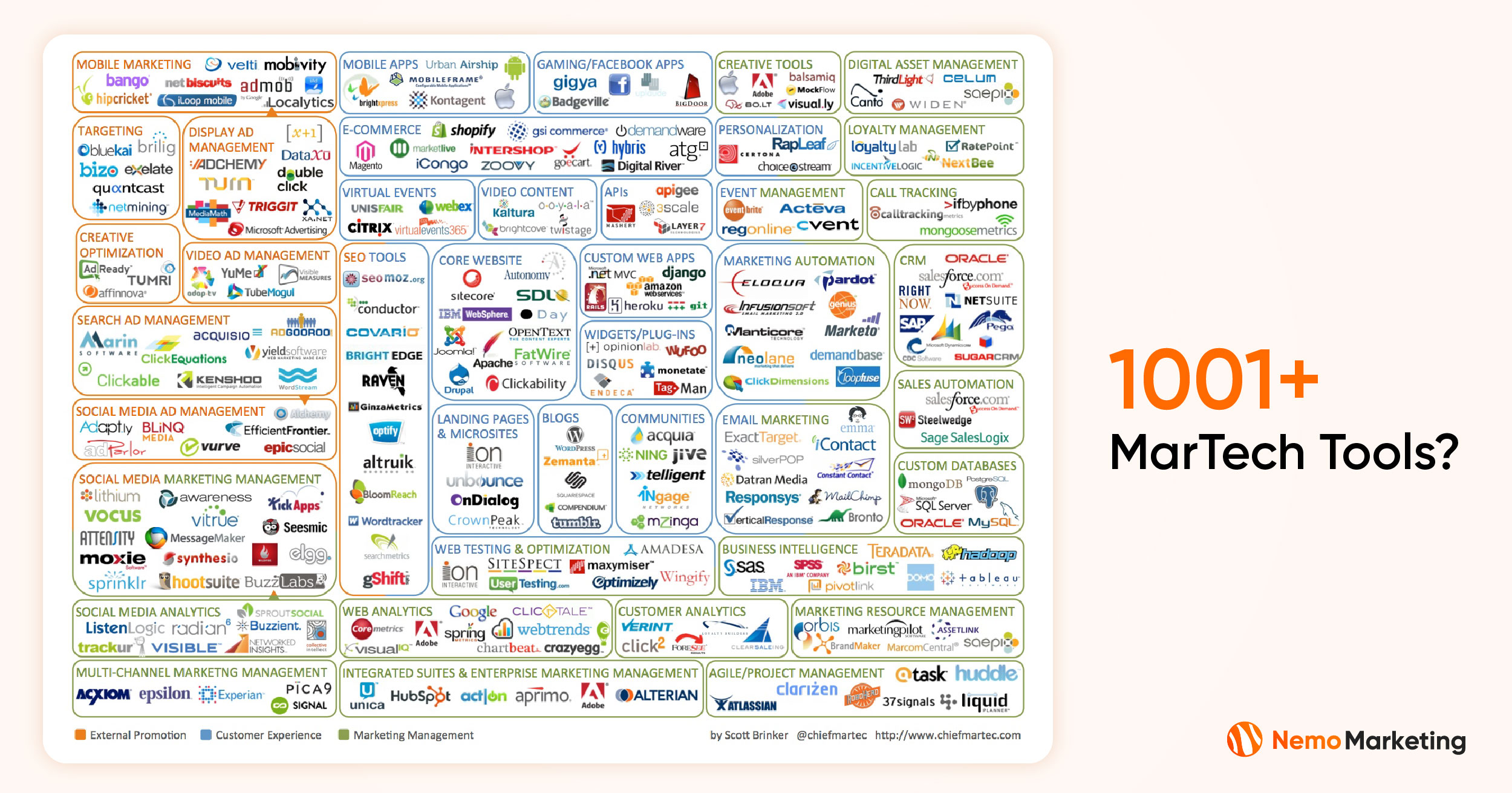
However, Martech Stack remains a relatively new concept for many marketers and businesses. Numerous businesses are still navigating the confusion of choosing the right Martech Stack from among the myriad of 1001+ tools available.
The company that I worked with went through a similar phase. We invested considerable resources, experimenting and facing setbacks, until we identified the best stack in the market, tailor-made for our business needs.
Therefore, in this article, I would like to introduce the Martech Stack that we have been using, offering it as a reference for you to directly consider and apply to your own business.
1- The Business Background and the Case Study
Firstly, let me introduce the business background to help you understand more about our company’s need for using the MarTech Stack.

Industry: Fintech (Financial Technology)
Business Model: A trading platform for financial products (such as Forex, Stocks, Indices, Crypto…). Customers access our platforms to buy and sell these financial products.
Business Goals:
- Expand the current customer base through acquisition activities, aiming for customer registrations and account deposits.
- Retain existing customers and elevate them to higher tiers, resulting in better revenue benefits.
Product Platforms: Website & Mobile Apps
Summary of Issues and Needs in Marketing Operations:
At the initial stage, the company’s Martech Stack was quite rudimentary and did not meet the business users’ requirements. Particularly, as a technology-focused company, these issues became more critical and were not easily addressable compared to non-tech companies.
To make it clearer for you, I’ll categorize them into user groups within the business and explain their specific issues.

A- Acquisition Marketing Team
- Requires an attribution tracking system to determine customer sources.
- Needs accurate Event Tracking on both Website and Mobile Apps for optimizing advertisements on various Ad Networks.
- Requires tools for Organic and Keyword Research to develop Organic Growth for Search channels on Website SERPs and Mobile App Stores.
- A/B Testing for different versions of Landing Pages is necessary.
- Automation of the reporting process and in-depth data analysis down to Ad Group level and Keyword level for advertising optimization.
B- Retention Marketing Team
- Needs a system to segment customers and attribute customers based on various criteria.
- Requires a system to manage and send remarketing messages through omni-channels.
- Automation of the reporting process, especially measuring the impact of remarketing activities on revenue and the effectiveness of retention and promotion.
C- Social Media Team
- Needs a tool to assist in managing and posting on social media.
- Requires a tool for automatic responses on fan pages.
- Automation of the effectiveness reporting process for social media.
D- Product Development Team
- Needs tools to measure Website and Mobile App product effectiveness for feature evaluation.
- Requires a storage system for Product Event data for long-term measurement purposes.
- Needs A/B Testing tools for Mobile Apps and Website to test new features and improve existing ones.
- Requires a tool to manage content on the Website.
- Automation of reporting processes for product features and product stability trends.
E- Business Team
- Requires tools for task delegation and project management.
- Automation of the overall business reporting process to optimize business operations.
2- MarTech Stack Planning
Understanding the needs of our user groups, we gradually researched and integrated new tools into our MarTech Stack. It can be said that we have gone beyond just the MarTech Stack, encompassing both the Product Stack and the Business Intelligence Stack.
After numerous changes (and failures), here are the tools in our current stack, providing stable operations that closely meet the user needs:

Seems like a lot of tools, doesn’t it? But don’t be overwhelmed by that.
In Section 1, we discussed the issues faced by business users. Right below, we will match those issues with each tool so you can understand the solutions they bring.
| Category | Tool | Roles and Functions |
| Organic Growth | AppTweak SEMRush Google Search Console | To boost Organic Growth by measuring and researching keywords for SEO (Website) and ASO (Mobile App Stores). |
| Tracking & Measurement | Appsflyer Google Analytics 4 Google Tag Manager Firebase FullStory | Support attribution tracking, event tracking, and measure Website and Mobile App product performance. |
| CRM | Custom CRM Salesforce | Store customer information and attributes, serving as an interface for business teams to manage customer relationships. |
| CMS | WordPress Strapi Custom CMS | Manage website content and banners across website and mobile app environments. |
| Customer Engagement | Braze Voiso ManyChat | Interact with customers through omni-channels, sales calls, and social media chat bots. |
| A/B Testing | Firebase VWO | Conduct A/B testing for different versions of content or product features on Website and Mobile Apps. |
| Social Media | Buffer | Automate post scheduling for multiple social media profiles in one place. |
| Project Management | Asana Figma | Project management and enhance team efficiency. |
| Data & reporting | Snowflake Google BigQuery MageAI Looker | Manage data flows, store data, transform data, and visualize data into user-friendly reports. |
| AI | ChatGPT | Address technical queries and expedite the content creation process. |
After reviewing all the tools mentioned above, do you identify any tools that your business might need?
If you’re interested, keep reading! In the upcoming articles, Nemo Marketing will delve deeper into specific tool categories to help you better understand the solutions they provide. This will enable you to consider incorporating them into your business.